
Agriculture today stands at the intersection of two urgent imperatives: mitigating climate change and restoring the ecological integrity of soils. Within this context, carbon farming and regenerative agriculture are approaches that aim to manage land sustainably. Understanding how these approaches align helps design strategies that are environmentally and economically sustainable.
Carbon Farming: A Market-Driven Climate Strategy
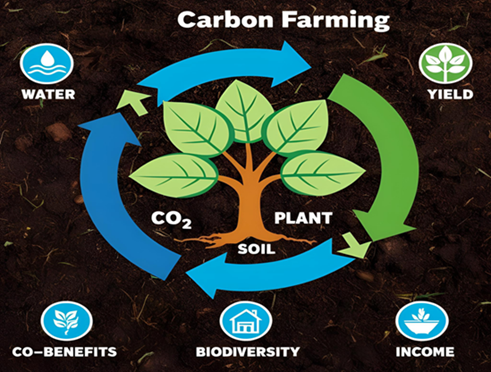
Carbon farming is fundamentally a climate-oriented approach. It encompasses a set of practices aimed at increasing soil organic carbon (SOC) stocks and reducing greenhouse gas emissions through measurable interventions. These practices are often linked to the generation of carbon credits, which quantify the amount of CO₂ removed or avoided and can be traded on voluntary carbon markets. This mechanism introduces a market-based incentive for farmers, transforming climate mitigation into a source of additional income. By monetizing the sequestration of carbon, carbon farming translates environmental stewardship into an economically rewarding activity, thereby accelerating adoption.
Regenerative Agriculture: Restoring Ecological Integrity
Regenerative agriculture, on the other hand, is rooted in ecological principles. Its primary goal is to restore soil health, enhance biodiversity, and reestablish natural nutrient cycles. It seeks to reverse the degradation caused by intensive farming systems through techniques such as crop rotation, cover cropping, compost application, and agroforestry. These interventions improve soil structure, increase water retention, and foster resilience against climatic extremes. Unlike carbon farming that is typically linked to quantified carbon outcomes (usually expressed in CO₂ equivalents and translated into credits), regenerative agriculture emphasizes broader ecological regeneration, process-based outcomes, and the multiple co-benefits it delivers to agroecosystems.
Points of Convergence: Shared Practices and Synergies
The convergence between carbon farming and regenerative agriculture becomes clear when focusing on the practices and system functions they jointly promote. Across both approaches, there is a strong emphasis on minimizing soil disturbance, reducing reliance on synthetic inputs, and integrating organic matter to support soil fertility. Cover crops, diversified rotations, and agroforestry systems serve as common pillars, simultaneously promoting carbon sequestration and ecological regeneration. This alignment creates a dual benefit: while regenerative agriculture improves the biological functionality of soils, carbon farming provides a quantitative framework to measure and certify these improvements, enabling their valorization in carbon markets. In this sense, carbon farming operationalizes selected regenerative objectives, particularly soil-carbon outcomes, by embedding them within climate policy and economic mechanisms.
Beyond technical similarities, the convergence reflects a deeper systemic logic. Healthy soils act as carbon sinks, and increased SOC not only mitigates atmospheric CO₂ but also enhances nutrient availability and water-holding capacity, reducing vulnerability to droughts and floods. These outcomes strengthen agroecosystem resilience, a core objective of both paradigms. Furthermore, the integration of carbon metrics into regenerative practices can foster transparency and accountability, helping ensure that sustainability claims are substantiated by verifiable data. This is particularly relevant in the Mediterranean context, where climate variability and soil degradation pose acute challenges to agricultural productivity and rural livelihoods.
Two Paths, One Goal
Ultimately, carbon farming and regenerative agriculture can be understood as two faces of the same transition toward climate-smart agriculture. One emphasizes ecological processes, the other quantification and market incentives, yet both converge on the imperative to restore soil functionality and reduce emissions. Their synergy offers a pathway to reconcile environmental integrity with economic viability, positioning farmers as key actors in the global effort to achieve climate neutrality. Embracing this convergence is not merely an option—it is a necessity for building resilient food systems in an era of unprecedented climatic uncertainty.
This article is based on the presentation of Ms. Roberta Farina PhD, Senior researcher at CREA – Council for Agricultural Research and Economics, called “Come coniugare Agricoltura rigenerativa e Carbon Farming”, from October 28, 2025.