
WHY THE RIGHT SOC MODELS MATTER FOR CREDIBLE AND WORKABLE IMPLEMENTATION
Carbon farming depends not only on what is done in the field, but also on how its impact is measured, modelled, and projected over time. It refers to agricultural practices that increase carbon storage in soils, vegetation, and biomass while helping reduce greenhouse gas emissions. Soil organic carbon (SOC), the carbon stored in soil organic matter, is central to this process. But in Mediterranean agriculture, its dynamics are difficult to capture. The real question is which models can support carbon farming in ways that are both credible and workable in practice.
With Carbon Farming MED, we address this challenge directly. Our findings show that a wide range of SOC models is already available, from simple empirical approaches to more complex process and ecosystem models. Some are useful for broad-scale reporting, but too coarse for local application. Others are scientifically rich, but require more data, expertise, and calibration than many real-world systems can provide.
Explore the key findings on SOC models for Mediterranean carbon farming here.
WHY MEDITERRANEAN CONDITIONS REQUIRE A DIFFERENT MODELLING LOGIC
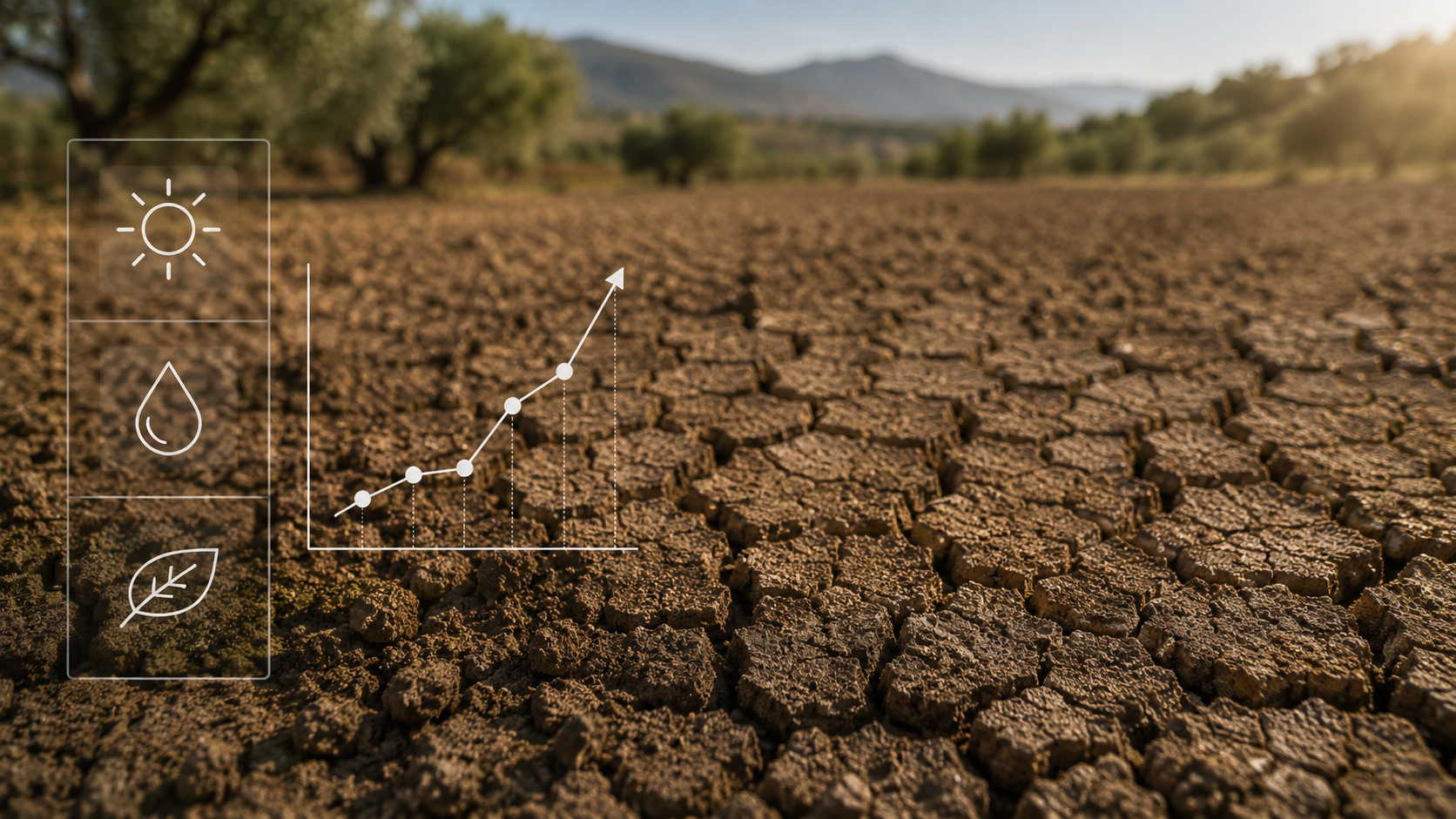
Mediterranean agriculture cannot be treated as a generic modelling context. Low baseline soil organic carbon, recurrent drought, erosion-prone soils, high spatial variability, and the importance of perennial systems such as vineyards and olive groves all make direct transfer of standard models difficult.
This matters not only for scientific accuracy, but also for implementation. If models are poorly adapted, they can weaken MRV systems, reduce trust in reported results, and make it harder to justify carbon farming measures in policy and market settings.
NOT ALL ROBUST MODELS ARE WORKABLE IN PRACTICE
In Selection and Adaptation of Optimal Carbon Soil Sequestration Predictive Models for the Mediterranean Region, we review several families of SOC models and conclude that different models serve different purposes depending on scale, data availability, and intended use.
Among the models reviewed, RothC stands out as one of the most suitable and widely applicable options for Mediterranean carbon farming contexts. Its main advantage is that it combines scientific robustness with relatively moderate input requirements, while still performing well for long-term SOC projections in diverse cropping systems. That makes it especially relevant where models need to be not only technically sound, but also realistic for wider application in advisory, policy, and MRV contexts.
THE REAL CHALLENGE IS NOT MODEL CHOICE ALONE, BUT MODEL USABILITY
Our findings also make it clear that choosing the right model is only part of the task. Reliability depends on calibration, validation, initialisation of SOC pools, and the quality of supporting datasets. In Mediterranean conditions, this remains challenging because long-term field data are limited, soils and management systems are highly heterogeneous, and scaling from the plot level to the regional level introduces additional uncertainty.
Model outputs are therefore context-dependent and should be interpreted as decision-support tools rather than fixed predictions. Their value depends on sustained monitoring, high-quality local data, and continued refinement over time.
This is why the most promising path is not model choice alone, but model integration. We point toward stronger coupling of SOC models with GIS, remote sensing, and digital tools that can support scaling and make modelling outputs more accessible for both institutions and end users.
FROM MODEL AVAILABILITY TO PRACTICAL IMPLEMENTATION
SOC models are not just analytical tools. They underpin MRV systems, support policy design, inform carbon credit credibility, and increasingly shape farm-level decisions. For carbon farming to scale in the Mediterranean, modelling must therefore do two things at once: remain robust enough to be trusted and accessible enough to be used.
This is where Carbon Farming MED makes its contribution. We help move the conversation from model availability to model suitability: not just which models exist, but which can actually support carbon farming under Mediterranean conditions.
Long-term progress will depend on integrated regional frameworks, continued investment in data collection and monitoring, and practical tools that enable robust modelling to be applied consistently across diverse Mediterranean farming systems.
Discover the full findings and recommended models here.